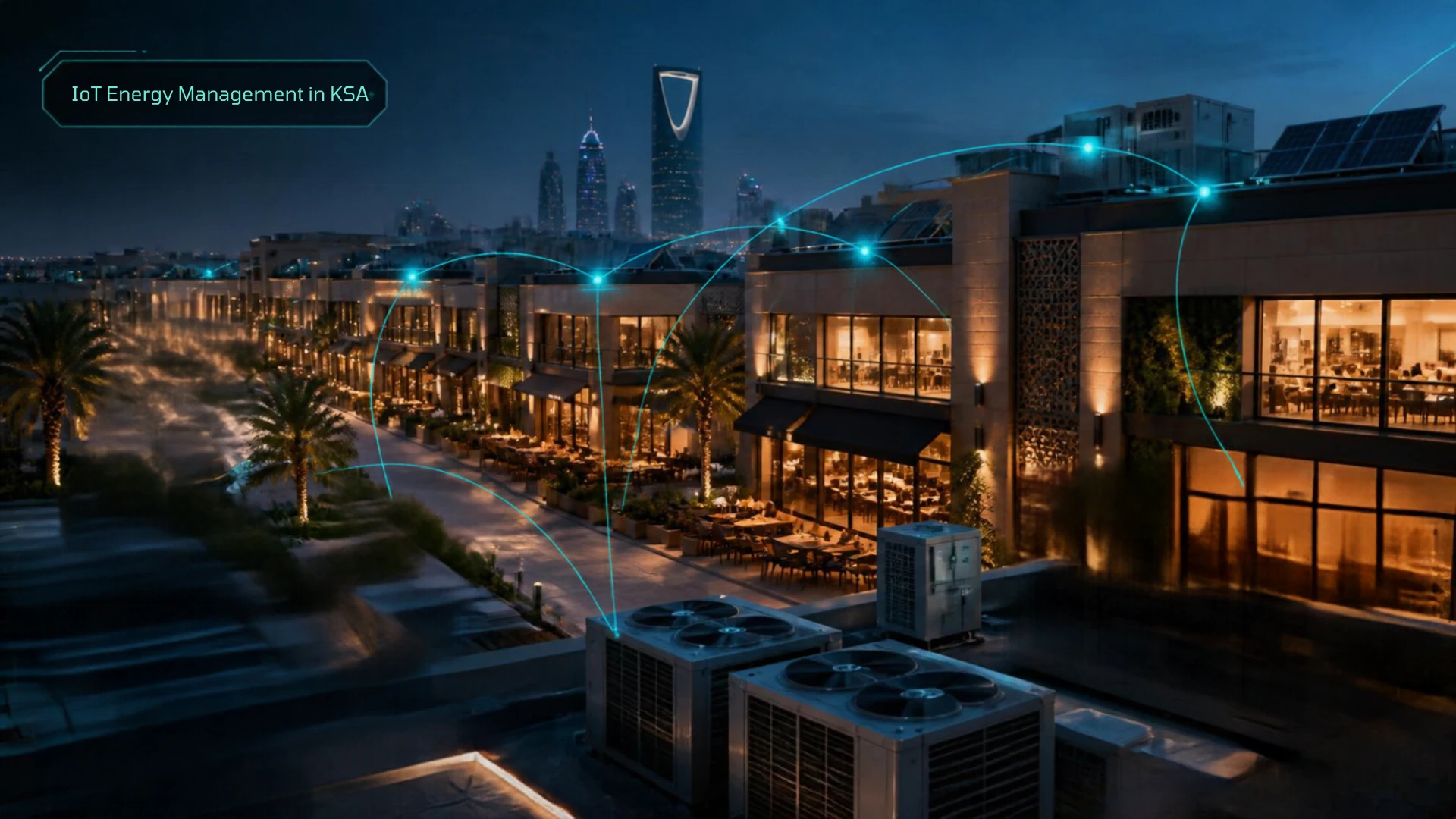
Why Multi-Site Retail and F&B Operators in Saudi Arabia Need IoT Energy Management
A single restaurant or convenience store is easy to keep an eye on. A network of 15, 50 or 120 branches across Riyadh, Jeddah and the Eastern Province is not. Head office sees one consolidated SEC bill a month, long after the electricity was actually used, with no way to tell which branch is running efficiently and which one is quietly bleeding cost through a stuck compressor or an HVAC unit left cooling an empty dining room.
IoT energy management closes that gap. Instead of one number a month, per-branch electricity use is visible in near real time, compared against every other branch in the network, and flagged automatically when something drifts out of normal range. For multi-site retail and F&B operators in Saudi Arabia, that shift from reactive to visible is often the single biggest lever available before any equipment is replaced.
Where Energy Waste Hides Across Multiple Retail and F&B Branches
The waste is rarely dramatic at any one site, which is exactly why it survives a monthly-bill review. It concentrates in a few repeatable places:
Refrigeration and walk-in coolers. Compressors drawing high standby current, door seals degrading slowly, defrost cycles running more often than needed. Multiplied across dozens of branches, this is usually the single largest recoverable load.
Kitchen extraction and HVAC. Ventilation and air conditioning sized for peak service hours but left running at the same output during quiet periods, or after closing.
Lighting and signage. Storefront signs, backlit menu boards and internal lighting left on well past closing, especially where timers are manual or unreliable across many locations.
Equipment left idle but powered. Fryers, ovens and display units warming up hours before the first customer, based on habit rather than actual opening time.
What an IoT Energy Management System Looks Like Across Many Sites
A system built for a single building and one stretched across a retail or F&B network need different things. For a multi-site operator, three capabilities matter most:
Per-branch, real-time visibility. Each site's consumption is metered down to circuit level, not just the main incomer, so a spike is traceable to refrigeration, HVAC or kitchen equipment without a site visit.
Cross-site benchmarking. Head office can rank every branch against the network average for its format and size, turning "our electricity cost went up" into "branch 14 is running 22% above comparable branches, starting three weeks ago."
Remote control, not just monitoring. Platforms like Eniscope Air let a facilities team adjust HVAC setpoints and schedules remotely across every branch from one dashboard, instead of relying on each site to manage its own thermostat.
Because this runs as a monitoring service rather than a capital project, sites can be added to the network in phases without a large upfront hardware spend, which matters when a rollout has to cover a chain rather than a single address.
Real Results from Multi-Site Retail and F&B Deployments
At Kudu, one of Saudi Arabia's most recognised quick service restaurant chains, deploying Eniscope asset tracking and Air Temp control across its branch network delivered 15 to 20% average savings in the initial phase of monitored stores, driven mainly by sub-metering high-draw fryers, walk-in coolers and ventilation, and standardising cooling cycles across sites that had previously been managed individually.
The same Eniscope platform IOTech deploys in Saudi Arabia has been used at network scale elsewhere: a 120-plus store rollout for 7-Eleven in Denmark saved 2,700,000 kWh and cut consumption by 11.52% on average, achieved largely through zero-cost behaviour and schedule changes once the network had real-time visibility, avoiding 864 tonnes of CO2 in the process. It is a useful reference point for what visibility alone, before any equipment upgrade, can do once it scales across many branches.
Rolling Out IoT Monitoring Across Many Branches Without Disrupting Trade
The practical concern for any multi-site operator is disruption: nobody wants installation crews interrupting service across dozens of active branches at once. In practice, monitoring hardware installs at the panel or circuit level in a matter of hours per site, without downtime, and a phased rollout, starting with a handful of representative branches, gives head office real comparison data before committing to the full network.
The lowest-friction starting point is a free energy waste report on one or two branches: a benchmark of that site's electricity use per square metre against comparable retail or F&B formats in Saudi Arabia, with an estimate of recoverable waste before any hardware is installed.
Frequently Asked Questions
Which IoT energy management system works best for multi-site retailers? The most effective systems for multi-site retail combine circuit-level metering at each branch with a single cross-site dashboard, so head office can benchmark every location against the network average rather than reviewing one bill at a time. Zero-CapEx, service-based deployment matters too, since it lets a chain phase a rollout across many branches without a large upfront hardware cost.
How does IoT energy monitoring work for food retail outlets specifically? Food retail and F&B sites concentrate their electricity waste in refrigeration, kitchen extraction and HVAC scheduling. IoT monitoring sub-meters those specific loads, so a walk-in cooler drawing abnormal standby current or an extraction system running outside service hours shows up automatically instead of being buried in a single monthly total.
Can one system compare energy performance across branches in different cities? Yes. Because every site reports into the same platform, head office can rank branches in Riyadh, Jeddah and the Eastern Province against each other on a like-for-like basis, adjusted for format and size, rather than comparing raw SAR spend across sites with different footprints.
Does rolling out IoT monitoring across many branches require CapEx or long installation time? No. Monitoring hardware typically installs at the panel or circuit level in a matter of hours per site without interrupting trade, and a Zero-CapEx, monitoring-as-a-service model means a multi-branch rollout doesn't need to be funded as a single capital project.
To see where a specific branch network stands against comparable retail and F&B sites in Saudi Arabia, IOTech's free energy waste report is the fastest starting point, or explore the energy monitoring platform behind it.
