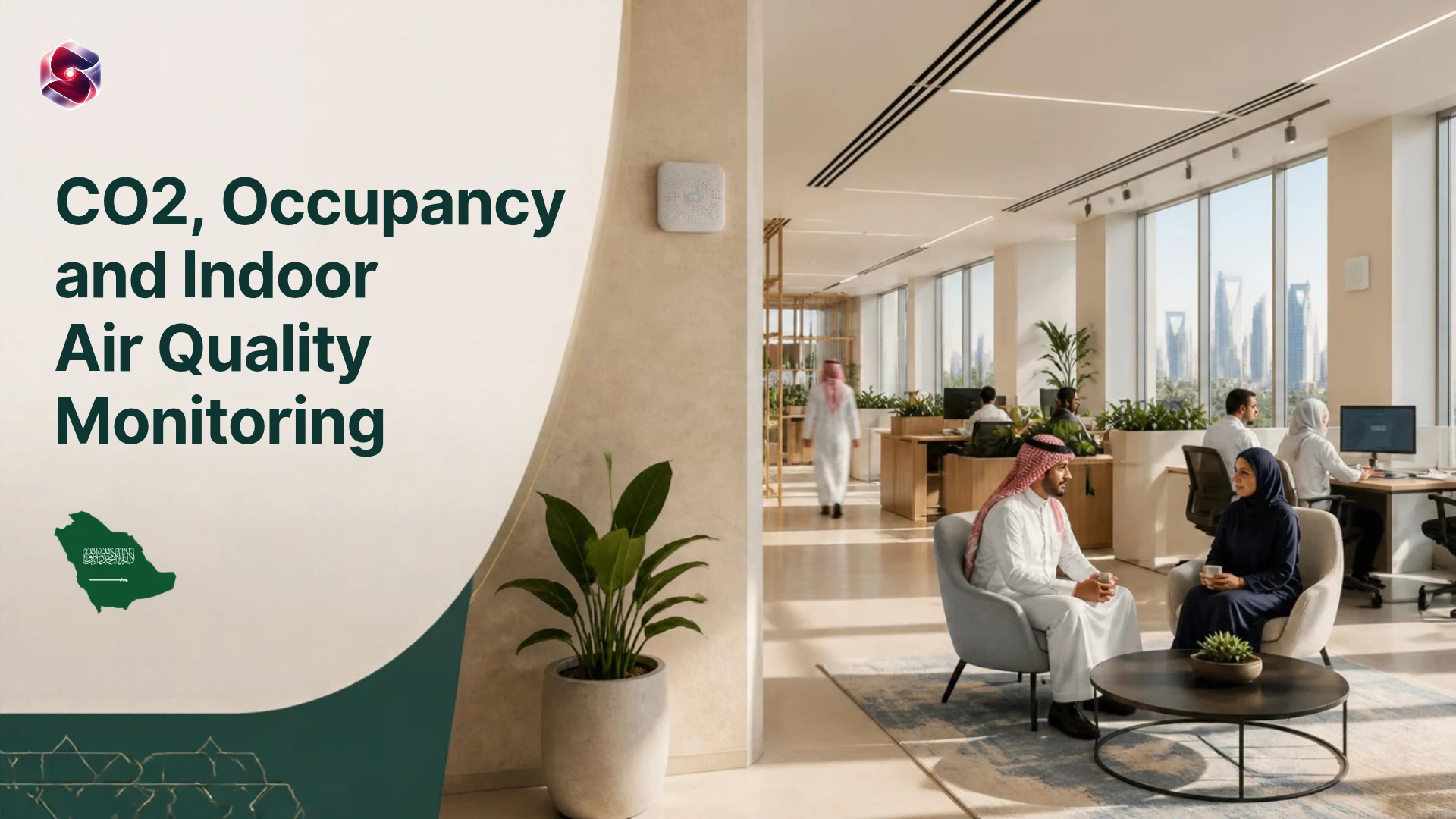
Why CO2, Occupancy and Air Quality Are Becoming Part of Saudi Building Management
Electricity, gas and water have an obvious cost, so they get metered first. Indoor air quality doesn't show up on a utility bill, which is exactly why it tends to be ignored until it becomes a complaint about a stuffy meeting room, a certification requirement, or an HVAC system that's quietly over-ventilating an empty floor around the clock. As Saudi Arabia's green building standards mature and commercial tenants and employers pay closer attention to indoor environment quality, CO2, occupancy and humidity monitoring are moving from a nice-to-have into a measurable, manageable part of building operations, alongside the electricity and water data facilities teams already track.
What CO2 and Occupancy Monitoring Actually Measures
Indoor CO2 concentration, measured in parts per million (ppm), is the standard proxy for how well a space is ventilated. Outdoor air sits around 420 ppm; a well-ventilated occupied room typically stays under 800 to 1,000 ppm, while poorly ventilated, densely occupied spaces can climb well past 1,500 ppm, a level widely associated with reduced concentration and increased drowsiness. Occupancy sensors add the other half of the picture: how many people are actually in a space at a given time, which is what should be driving ventilation rate, not a fixed schedule set at commissioning and never revisited.
Paired with temperature and humidity data, these sensors give a facilities team a real-time read on whether a building's HVAC system is doing the right amount of work, not too little, which hurts air quality and occupant wellbeing, and not too much, which wastes electricity ventilating and conditioning air that nobody needs.
The Business Case: Air Quality and Energy Cost Are the Same Problem
Ventilation and air quality are usually treated as a facilities or health and safety topic, separate from the energy conversation. In practice they're the same system viewed from two angles. A meeting room ventilated on a fixed high-occupancy schedule regardless of whether it's actually full is wasting conditioning energy on air nobody is breathing. A conference floor that only ventilates on a timer, not on actual CO2 levels, can simultaneously be over-cooling half-empty rooms and under-ventilating a packed one two doors down.
Demand-controlled ventilation, adjusting fresh air intake based on real-time CO2 and occupancy rather than a fixed schedule, is one of the more straightforward efficiency gains available in commercial HVAC, because it targets waste that a standard electricity sub-metering exercise won't surface on its own: the building may be consuming exactly what its schedule says it should, and the schedule itself is the problem.
Where This Fits with Mostadam and ISO 50001
Saudi Arabia's Mostadam certification and international frameworks it draws on increasingly weight indoor environmental quality, including ventilation performance and occupant comfort, alongside pure energy metrics. ISO 50001's continuous-improvement requirement also benefits from having occupancy data on hand, since it lets a facilities team defend an energy reduction target with evidence that comfort and air quality weren't sacrificed to hit it. Buildings pursuing either certification are increasingly being asked for exactly this kind of data, not just an electricity trend line.
What an IoT CO2 and Occupancy Monitoring Deployment Looks Like
The same sensor and platform approach IOTech uses for electricity, gas and water monitoring extends to CO2, temperature, humidity and occupancy: wireless sensors placed in representative zones (meeting rooms, open-plan floors, dense-occupancy areas like restaurants or classrooms), reporting into the same real-time dashboard used for energy data, with alerts when a zone crosses a CO2 or humidity threshold rather than waiting for someone to notice the room feels stale. For a facilities team already using IoT for smart building energy management, adding air quality and occupancy sensors is usually an extension of the existing platform rather than a separate system to procure, install and learn.
Deployed as a service rather than a capital purchase, the same Zero-CapEx model IOTech uses for energy monitoring applies here: sensors installed in representative zones within hours, with data flowing into the dashboard the same day.
Frequently Asked Questions
What is a good indoor CO2 level for an occupied commercial building? Most indoor air quality guidance treats CO2 below 800 to 1,000 ppm as well-ventilated for an occupied space. Levels consistently above 1,500 ppm generally indicate under-ventilation relative to occupancy and are associated with reduced concentration and increased drowsiness among occupants.
Does CO2 and occupancy monitoring actually save energy, or is it only about air quality? Both. Ventilation systems set to a fixed schedule regardless of real occupancy routinely over-ventilate empty or lightly used spaces, wasting conditioning energy, while under-ventilating densely occupied ones at the same time. Monitoring real occupancy and CO2 lets HVAC respond to actual conditions instead of a fixed timer, which is where the energy saving comes from.
Is indoor air quality monitoring required for Mostadam or ISO 50001 certification in Saudi Arabia? Indoor environmental quality, including ventilation performance, is an increasingly weighted component of Mostadam and the frameworks it references, and ISO 50001's continuous-improvement requirement benefits from occupancy and air quality evidence alongside energy data. Requirements vary by certification tier and building type, so it's worth checking current scoring criteria for a specific project.
Can CO2 and occupancy sensors be added to a building that already has electricity or water monitoring installed? Yes. Because CO2, temperature, humidity and occupancy sensors report into the same IoT platform used for utility monitoring, they're typically added as an extension of an existing deployment rather than a separate system, and install in representative zones within hours.
To see what an air quality and occupancy assessment would find in a specific building, get in touch via IOTech's contact page, or explore the full monitoring platform this extends.
