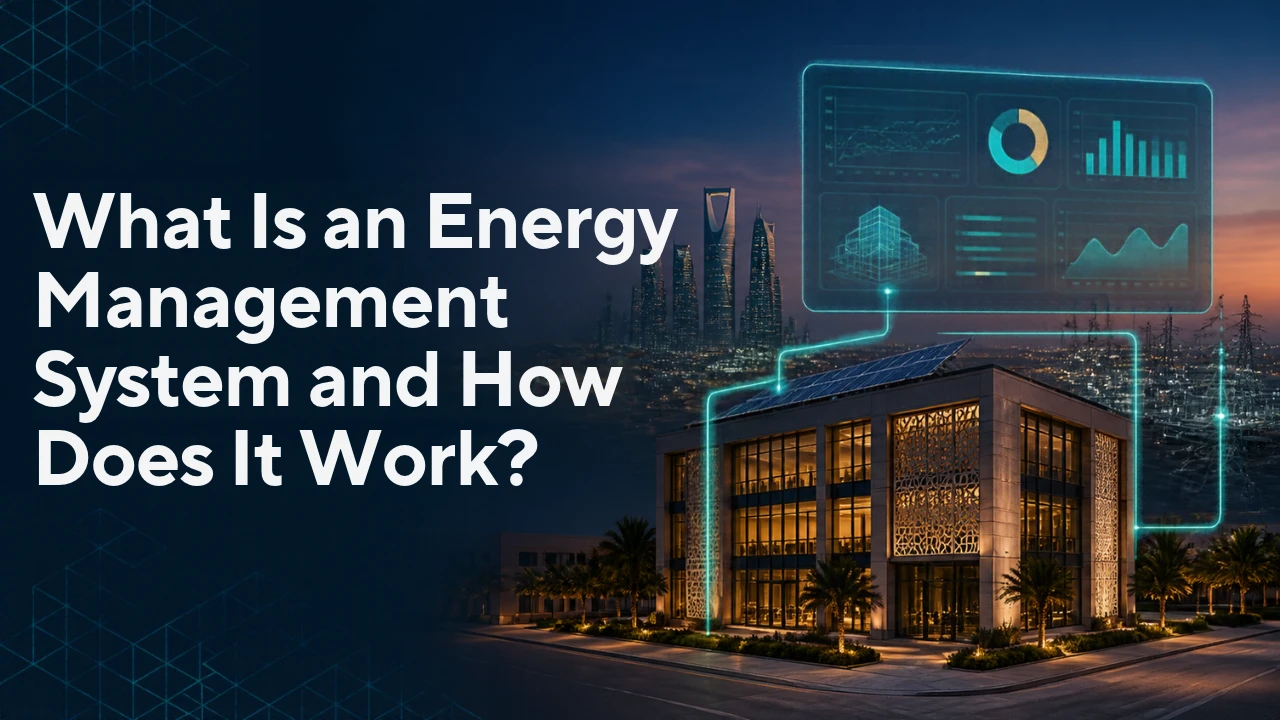
In short: An energy management system (EMS) is the combination of meters, software and routines that measures how a building or plant uses energy, shows where it is wasted, alerts you when something drifts, and helps you act and verify the savings. It works in five steps: measure, send, analyse, act and verify. On its own it saves nothing, but it makes waste visible, and visible waste gets fixed.
What an energy management system is
The term is used in two ways, and it helps to separate them. In the technical sense, an EMS is the system of meters, sensors and software that collects and analyses energy data. In the organisational sense, an energy management system is the process an organisation follows to set a baseline, targets and actions and keep improving, which is what the international standard ISO 50001 describes; see our guide to ISO 50001 certification. The two work best together: the process decides what to improve, and the monitoring system supplies the evidence that it is happening.
How it works in five steps
- Measure. Clip-on current sensors (CTs) are fitted around the cables at the distribution board, and a hub reads voltage, current, power and power factor for each circuit. Wireless sensors add temperature, humidity, CO2 and occupancy, and pulse inputs can read water and gas meters. IOTech's Eniscope hub, for example, reads up to eight three-phase circuits at one-second resolution.
- Send. The hub sends the readings over your network to a secure cloud platform. Nothing about the building's electrical supply changes, and the utility meter is untouched.
- Analyse. The platform builds a baseline of how the site normally behaves by hour and day, calculates cost and carbon, and highlights peaks, poor power factor and unbalanced phases.
- Act. Alerts flag problems as they happen, such as a compressor running overnight or an air conditioner outside its schedule. Schedules and remote control can switch non-critical equipment off, and a Virtual Energy Manager service reviews the data and recommends actions.
- Verify. Results are compared with the baseline, so you can show what was saved and what it paid back. Costs can be allocated by site, process or product.
What an EMS shows that a monthly bill cannot
A monthly utility bill tells you how much energy a site used, not where, when or why. A monitoring system shows which circuit or machine is responsible, at what time of day, and how that compares with last week. That is how out-of-hours load, equipment started too early and machines running at full output on a light day are found. These are rarely single large faults; they are many small ones that add up, and none of them appears on the bill.
EMS, BMS and energy audit: how they differ
- EMS: continuous measurement and analysis of energy use across the site, to find and prove savings.
- BMS: real-time control of building systems such as air conditioning and lighting. It acts on the building; an EMS reports on the energy it uses.
- Energy audit: a point-in-time study of where energy is lost. It is a snapshot, and monitoring keeps the fixes in place afterward. See our guide to energy audits in Saudi Arabia.
What you need to get started
You need access to the distribution boards, a network connection for the hub, a list of the loads that matter most, and your recent utility bills for the baseline. The hub and sensors are usually installed in under eight hours, wirelessly where possible, without cutting cables or stopping the business.
Who benefits most
Sites with many circuits, long operating hours or several locations see the clearest returns: restaurants and food retail, hotels, schools, manufacturing plants and multi-site commercial portfolios. Our complete guide to energy management systems in Saudi Arabia covers the sectors in detail.
What results to expect
In our client projects, savings have ranged from 9% to more than 26%. Kudu Restaurants reported 15 to 20%, Transmed 9.34%, and Tex Plastics more than 26% with a payback of about three months, while Nova Waters paid back in 1.8 years. Results depend on the site and on acting on what the data shows.
Why it matters more from 2027
Commercial electricity rates rise to 25 and 35 halalas per kWh on 1 January 2027, as explained in our guide to the 2027 tariff. Every kWh a monitoring system helps you avoid becomes worth more, which shortens payback.
How IOTech can help
IOTech Energy installs and runs energy management systems built on the Eniscope platform, with a 24/7 service level agreement. Send us one recent SEC bill and we will run a free 30-minute Energy Waste Assessment that estimates where your site is likely losing energy and what monitoring could save. Book through our contact page, or see our energy management solution.
Frequently asked questions
What is an energy management system in simple words?
It is a set of meters, sensors and software that measures how a building or plant uses energy, shows where it is wasted, alerts you when something changes, and helps you act on it and prove the savings.
How does an energy management system save energy?
It does not save energy by itself. It makes waste visible, such as equipment running after hours or machines drawing more than they should, so that you can fix it and then confirm the result against a baseline.
What is the difference between an EMS and a BMS?
A building management system (BMS) controls building systems such as air conditioning and lighting in real time. An energy management system measures and analyses energy use across the site and finds where to save. They complement each other, and a site can have one without the other.
Is an energy management system the same as ISO 50001?
Not exactly. ISO 50001 is the international standard for an energy management system in the organisational sense: how you set a baseline, targets and actions and keep improving. A monitoring system supplies the data that makes that process work. You can use a monitoring system without being certified.
How long does installation take?
The hub and clip-on current sensors at a distribution board are usually installed in under eight hours, and the cables do not need to be cut. Larger sites with several boards take longer.
Do I need to replace my existing meters?
No. The sensors clamp around existing cables, and the utility meter stays where it is. The monitoring system adds measurement inside your site, circuit by circuit.
