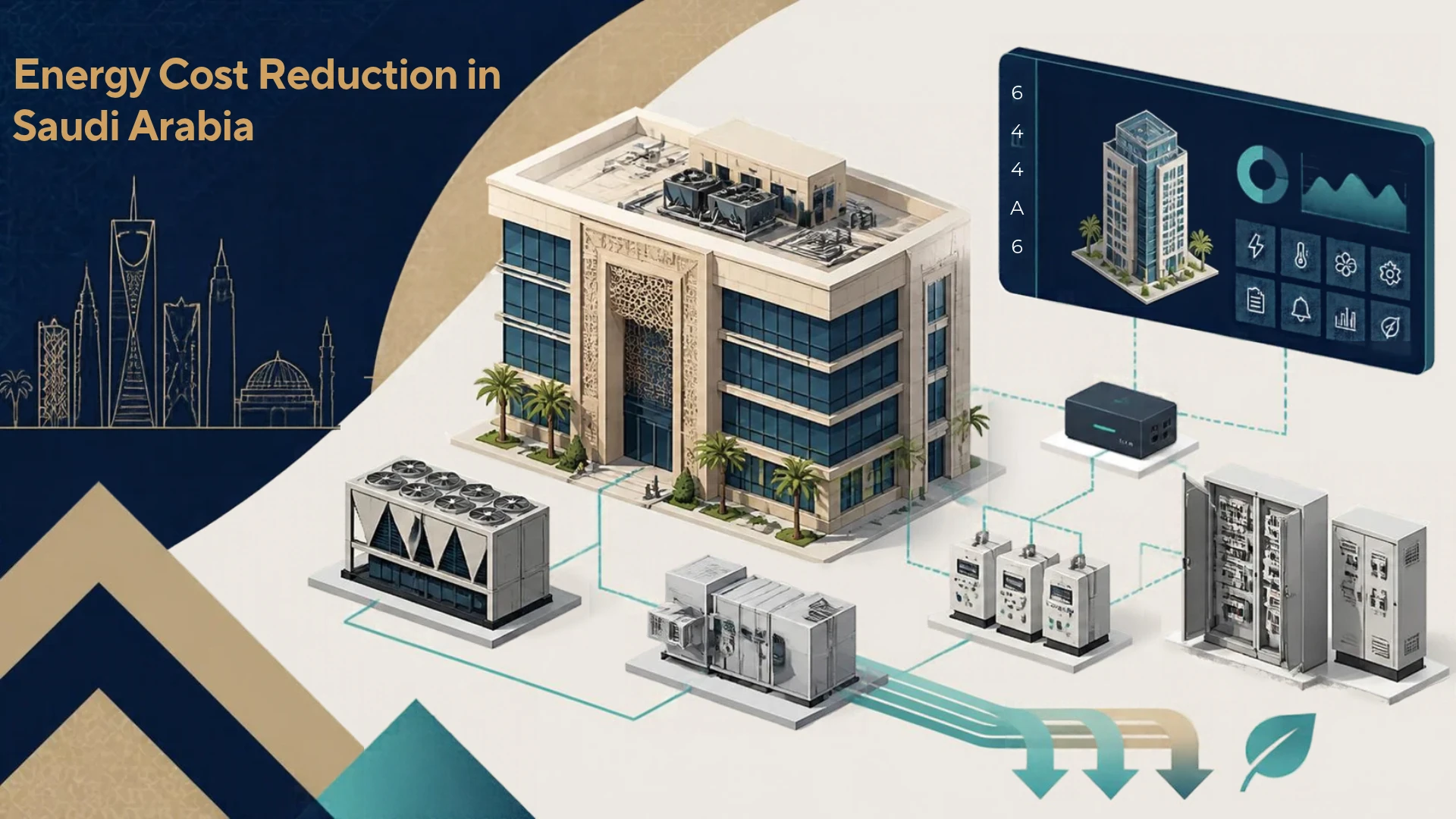
Electricity is usually the fastest-moving line on a Saudi commercial building's operating budget, and it rarely moves in the direction anyone wants. Between the way the tariff is structured, peak loads nobody coordinates, and equipment that quietly runs outside business hours, most facilities are paying for far more energy than they actually use for productive work. The businesses that bring that number down aren't doing anything exotic: they're following a specific, repeatable sequence, and they're measuring the result instead of guessing at it.
Where Saudi commercial energy costs actually come from
Before any cost-reduction plan works, it has to be aimed at the right target. Across the sites IOTech monitors in Saudi Arabia, three cost drivers show up again and again:
Baseline load that never switches off. HVAC, refrigeration, and process equipment left running overnight or on closed days. This is invisible on a monthly SEC bill and is usually the single largest source of avoidable spend.
Peak, uncoordinated load. Starting every large load at the same moment strains the electrical system and wastes energy at the worst possible time. Understanding how commercial electricity tariffs in Saudi Arabia are structured changes which equipment gets scheduled and when.
Waste nobody can see until it's measured. Equipment operating at full output on part load, compressors and chillers cycling inefficiently, or a single faulty asset pulling a disproportionate share of a circuit's power.
Step 1: Know your baseline before you change anything
An energy audit establishes exactly where a facility's electricity is going before any money is spent on fixes. Skipping this step is the most common reason cost-reduction projects underperform: without a baseline, it's impossible to prove what a change actually saved, or to prioritise the interventions with the fastest payback first.
Step 2: Understand what you're actually being charged for
Saudi commercial electricity is billed in consumption tiers, and depending on the account it can also include a charge for poor power factor on larger connections and fixed meter fees. Knowing which components apply to your own bill shows where the real savings sit, and they're often different from where a facility manager assumes. Correcting a poor power factor, for example, can remove a charge without cutting a single kWh of useful output, while shifting avoidable overnight load cuts the energy bought in the first place.
Step 3: Monitor in real time, not once a month
A monthly SEC invoice tells a facility what it spent 30 days ago. By the time a spike shows up on a bill, the equipment that caused it may have been running inefficiently for weeks. Real-time energy management puts consumption data in front of the people who can act on it as it happens, down to the circuit or machine, not just the building.
This is also where indoor conditions and occupancy tie back into cost: CO2 and occupancy monitoring lets HVAC run to match how a space is actually being used instead of a fixed schedule, which is one of the most common sources of the baseline waste described above.
Step 4: Turn visibility into an action list, not just a dashboard
A dashboard that nobody reviews doesn't save anything. The sites that see the largest reductions treat monitoring data as a prioritised, ongoing action list: which asset to fix first, what it's costing per month, and what fixing it is worth. This is the difference between having data and actually reducing a bill.
What this looks like in practice
Results vary by sector and building type, but the pattern holds across every Saudi and regional site IOTech has monitored:
Kudu, a Saudi quick-service restaurant chain, is achieving 15 to 20% average savings across its monitored branches in Riyadh.
Nova Waters, a Riyadh bottled-water manufacturer, reached a 1.8-year payback period on its monitoring investment, a timeline driven entirely by verified savings.
Transmed, a regional food distributor managing refrigeration-heavy warehouses, achieved 9.34% electricity savings by making chiller and compressor consumption visible for the first time.
On the manufacturing side, Tex Plastics identified more than 26% in energy savings with a 3-month payback once granular, per-machine data was in place, a scale of result that's realistic anywhere baseline visibility has been missing.
The fastest way to start
Most Saudi facilities don't need a capital project to start cutting costs. IOTech's Energy Waste Assessment is a free, 30-minute review built from one recent SEC bill: a written, costed estimate of where a site is likely losing money, with no charge and no obligation. It's the same starting point behind every case study above.
Frequently Asked Questions
How can a business reduce energy costs in Saudi Arabia? Start with a baseline audit, understand the tariff structure driving the bill rather than just total consumption, then add real-time monitoring so waste is visible and actionable rather than discovered a month later on an invoice.
How much can a commercial building save on electricity in Saudi Arabia? Saudi and regional sites monitored by IOTech typically see 10 to 26% in verified savings, depending on building type and how much baseline waste existed before monitoring began.
What is the fastest way to lower an SEC electricity bill? Identifying and fixing equipment that runs outside business hours (HVAC, refrigeration, process loads) is usually the single fastest win, since it requires no capital investment, only visibility.
Does energy monitoring reduce costs on its own, or does it just report them? Monitoring alone only reports usage. The savings come from acting on what it shows, which is why IOTech pairs monitoring data with a prioritised action list rather than a dashboard alone.
